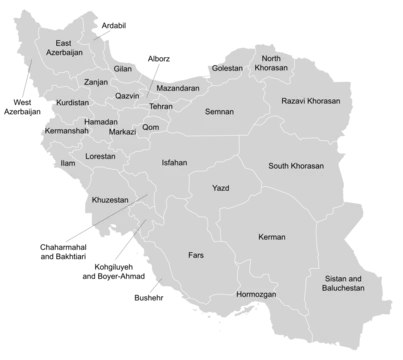
Gilan province
A Caspian province with ancient roots and a history of independence.

Mahdi Almasi · CC BY 4.0
Gilan Province is one of the 31 provinces of Iran, located in the northwest of the country along the southwestern coast of the Caspian Sea. Its capital is Rasht. The province has a long history of human habitation dating back to the Lower Paleolithic, and its people, the Gilaks, have origins linked to the Caucasus. While Gilan was never permanently conquered by Muslim Arabs, it did experience Arab raids and temporary incursions. Later, the province became a major silk producer, making it one of the wealthiest in Iran.
- Historical Significance
- Place of origin of the Ziyarid dynasty; the Buyid dynasty originated in Deylaman, historically distinct from lowland Gilan. Never permanently conquered by Muslim Arabs, though Arab raids and temporary
Lore & Background
Early humans were present in Gilan since the Lower Paleolithic, with Darband Cave being the earliest known habitation site. The Gelae, or Gilites, entered the region south of the Caspian coast in the second or first century BCE, possibly from Dagestan. Their Y-DNA closely resembles that of Georgians and other South Caucasus peoples, while their mtDNA resembles other Iranian groups. The province was the origin of the Ziyarid dynasty in the mid-10th century; the Buyid dynasty originated in Deylaman, a historically distinct region. Muslim Arabs never permanently conquered Gilan, though they carried out raids and temporary incursions; the Gilanis and Deylamites repelled most Arab attempts. Deylamite mercenaries served as far away as Egypt, al-Andalus, and the Khazar Kingdom.
Reader's Guide
Gilan Province holds a unique place in Iranian history due to its successful resistance against Arab conquest and its role as a center of the Ziyarid and Buyid dynasties. The province's silk production from the 15th century onward made it one of the wealthiest in Iran and a key source of revenue for the Safavid empire. The region experienced Russian occupation in the early 18th century and later significant Russian influence, which contributed to the Persian Constitutional Revolution. Gilan's cultural and genetic ties to the Caucasus, along with its distinct history of independence, mark it as a region with a strong and enduring identity within Iran.
Did You Know?
- Darband Cave in Gilan contains evidence of the earliest prehistoric human cave occupation during the Lower Paleolithic in Iran.
- Muslim Arabs never permanently conquered Gilan, though they launched raids and temporary incursions into the region.
- Gilan was a major exporter of silk in Asia from the 16th century until the mid-19th century.
- The Y-DNA of Gilaks most closely resembles that of Georgians and other South Caucasus peoples.
Geography & Urban Landscape
Gilan Province stretches along the southern shore of the Caspian Sea, occupying Iran's northwest corner within what is designated as Region 3. Its capital, Rasht, sits at the province's center, while the main seaport, Bandar-e Anzali (once called Bandar-e Pahlavi), anchors the coastal economy. To the west lies Ardabil province, to the east Mazandaran, and to the south Zanjan and Qazvin. In the north, a short border with Azerbaijan's Astara District marks the province's edge. The northern reaches of Gilan form part of the South Talysh territory, a cultural zone that adds another layer to the region's identity. Beyond Rasht and the port, a constellation of towns dots the landscape—Lahijan, Langarud, Masuleh, Rudbar, Rudsar, Shaft, Siahkal, Sowme'eh Sara, Astara, Fuman, Hashtpar, Manjil, and Astaneh-ye Ashrafiyeh—each contributing to a patchwork of settlements that have evolved around the province's rivers, forests, and coastline.
Deep Prehistory & Ancient Inhabitants
Evidence of human presence in Gilan stretches back to the Lower Paleolithic, making it one of the oldest continuously inhabited regions in Iran. Darband Cave, tucked into a deep tributary canyon of the Siah Varud river, holds the earliest known prehistoric cave occupation in the country, with stone tools and animal fossils dating to the late Chibanian period. Further up the timeline, the Yarshalman shelter was likely home to Neanderthals between 40,000 and 70,000 years ago, while Chapalak Cave and the Khalvasht shelter preserve later Paleolithic layers. The region's ancient inhabitants also carry a distinct genetic signature: Y-chromosome data links Gilaks most closely to Georgians and other South Caucasus peoples, while their mitochondrial DNA aligns with broader Iranian groups. Their languages share typological features with Caucasian tongues, and classical sources suggest the Gelae (or Gilites) arrived from the Dagestan area in the second or first century BCE, displacing or absorbing the earlier Cadusii.
The Deylamite Era & Medieval Power
For centuries, Gilan and its neighboring Deylamite lands projected military power far beyond their borders. During the Sassanid period, local rulers extended their influence into Mesopotamia. When Arab armies first clashed with Gilak and Deylamite forces at the Battle of Jalula in 637 AD, commander Muta led a coalition of Gils, Deylamites, Persians, and men from the Rey region. Though Muta fell and the army retreated in an orderly fashion, the Arabs never fully subjugated the province. Gilanis and Deylamites repeatedly repelled attempts to occupy their territory or impose Islam. By the mid-10th century, the Buyid dynasty—born from Deylamite roots—conquered Baghdad in 945 under Mu'izz al-Dawla, who kept the Abbasid caliphs in comfortable seclusion. Deylamite mercenaries served in Egypt, al-Andalus, and the Khazar Kingdom, and Muslim chronicles note they were the only Caspian warriors who could match the Varangian Vikings in battle. The Ziyarid dynasty also originated here, cementing Gilan's role as a crucible of Iranian political power.
Economic Transformation & the End of Autonomy
Before the introduction of silkworm cultivation in the late Middle Ages, Gilan was a modest, somewhat isolated province with no permanent trade routes linking it to the Persian heartland. Its economy relied on small-scale commerce in smoked fish and timber, and the nearby city of Qazvin was originally built as a fortress to guard against Deylamite raiders—a telling sign that the province could not sustain its population through local production alone. The arrival of silk production transformed this picture entirely, turning Gilan into an economic pillar by the fifteenth century. Politically, the province had long maintained a degree of independence, with local rulers paying tribute to whichever power dominated south of the Alborz mountains. Brief periods of nominal Ottoman suzerainty occurred in 1534 and 1591, though no tribute was actually rendered. The final chapter of Gilan's autonomy closed when Safavid Shah Abbas I ended the rule of Khan Ahmad Khan, the last semi-independent governor, and annexed the province directly into the imperial domain.
Gallery
Frequently Asked Questions
What is Gilan Province?
Gilan is one of Iran's 31 provinces, positioned in the northwest along the southwestern shore of the Caspian Sea, with Rasht as its capital city.
What is Gilan Province historically famous for?
The region is best known for its centuries-old silk trade, which made it one of the wealthiest areas in Iran. It also served as the birthplace of the Ziyarid dynasty, while the nearby Deylaman region gave rise to the Buyid dynasty.
Was Gilan ever permanently conquered by Muslim Arabs?
No, Gilan was never permanently taken over by Arab Muslim forces, despite suffering raids and brief incursions over the centuries. This record of sustained independence is a defining part of the province's identity.
How far back does Gilan's history of habitation go?
Human presence in the area dates to the Lower Paleolithic era, making it one of the oldest continuously inhabited zones in Iran. The Gilak people trace their ethnic origins to the Caucasus region.
Why is Gilan Province considered important in Iran's broader story?
Its Caspian Sea location, ancient silk wealth, and notable track record of resisting permanent foreign conquest all mark it as a historically significant province. Gilan also produced major dynastic lineages such as the Ziyarids and the Buyids, shaping Iranian political history.
More in Provinces Of Iran 1-24
Elsewhere in the Provinces Of Iran universe
Spotted an error? Know more?
This is a living reference — every entry is fact-audited, and reader corrections feed straight into our audit queue. Suggest an edit · See this site's audit record