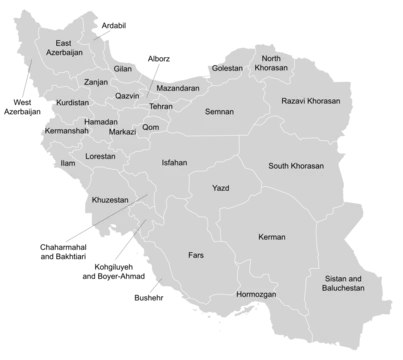
Khuzestan province
Southwest Iranian province, ancient Elam, key strategic region.

Khuzestan province is one of the 31 provinces of Iran, located in the southwest of the country, bordering Iraq and the Persian Gulf. The province comprises much of what historians refer to as ancient Elam, whose capital was at Susa, and was once one of the most important regions in the Ancient Near East.
- location
- Southwest Iran, bordering Iraq and the Persian Gulf
- capital
- Ahvaz
- historical_region
- Comprises much of ancient Elam
- key_resource
- Contains Iran's largest oil field
Lore & Background
Khuzestan's name derives from the Old Persian word Hūjiya 'Elam', appearing on Achaemenid inscriptions. In Middle Persian it became Huź, then Xuz, and the modern form Khuzestan. The city of Ahvaz shares this origin, being an Arabic broken plural from Suq al-Ahvaz 'Market of the Huzi'. A folk etymology holds that 'khuz' means sugar, as the province has been a cane sugar-producing area since late Sassanian times. Khuzestan was home to the Elamite civilization, a non-Semitic, non-Indo-European-speaking kingdom and the earliest civilization within the borders of what would later be called Persia. Later, Elam was incorporated into the Median Empire, then conquered by Cyrus the Great, who made Susa one of the Achaemenid capitals. After Alexander the Great's conquest, the Seleucid dynasty ruled, followed by the Parthians and then the Sassanids. The Sassanids built extensively in Ahvaz, Shushtar, and north of Andimeshk, and founded the Jondi-Shapur Medical School. The region came under Umayyad and Abbasid rule until the Saffarid dynasty regained control. In modern times, there has been episodic conflict between the province's Arab population and the central government.
Reader's Guide
Khuzestan province holds profound historical significance as the heartland of ancient Elam, the first 'Iranian' empire in a geographic sense, and as a key region in the Ancient Near East. Its capital Susa served as one of the Achaemenid capitals, and the province later became a center of Sassanian culture and learning, notably through the Academy of Gundishapur. The Muslim conquest integrated Khuzestan into the Islamic world, and subsequent Iranian dynasties maintained control. In modern Iran, Khuzestan's strategic importance is underscored by its possession of Iran's largest oil field, making it a key economic and geopolitical asset. The province's name and identity have evolved over millennia, reflecting layers of Elamite, Persian, Arab, and Islamic influence. Understanding Khuzestan is essential for grasping the deep historical roots of Iranian civilization and the contemporary dynamics of the region.
Did You Know?
- The name Khuzestan derives from the Old Persian word Hūjiya, meaning 'Elam'.
- The province contains Iran's largest oil field.
- The city of Ahvaz shares its name origin with Khuzestan, from Suq al-Ahvaz 'Market of the Huzi'.
Frequently Asked Questions
Where exactly is Khuzestan province located?
It sits in southwestern Iran, sharing a border with Iraq to the west and opening onto the Persian Gulf to the south. This dual border with a foreign nation and a major waterway gives it a distinctly strategic position on the map.
What historical significance does Khuzestan province hold?
The province encompasses much of the territory once known as ancient Elam, whose capital city of Susa lay within these borders. In antiquity, this made the area one of the most politically and culturally influential zones in the entire Near East.
Why is Khuzestan province considered important to Iran?
It contains what is described as Iran's largest oil field, making it a cornerstone of the country's energy output. Combined with its Iraq border and Persian Gulf coastline, it is a key strategic asset for both economic and security reasons.
More in Provinces Of Iran 1-24
Elsewhere in the Provinces Of Iran universe
Spotted an error? Know more?
This is a living reference — every entry is fact-audited, and reader corrections feed straight into our audit queue. Suggest an edit · See this site's audit record